

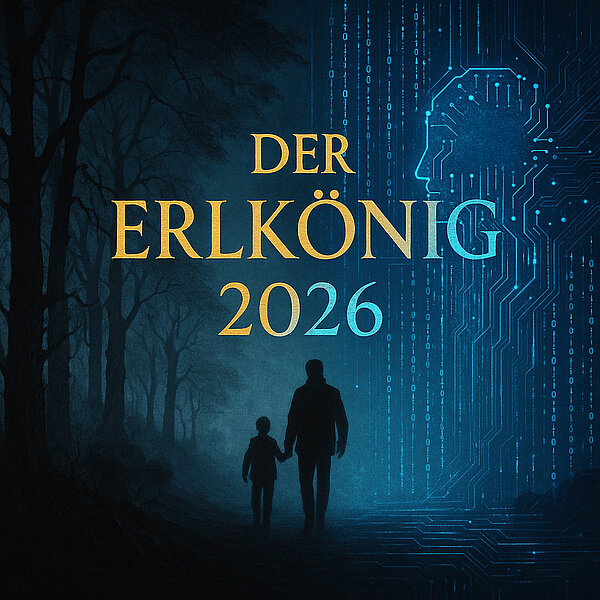
The Erlking 2026: Goethe’s ballad meets artificial intelligence
“The Erlking 2026” is a modern ballad by the artist Halumina. This poetic reinterpretation of Goethe’s renowned work is set within an electronic soundscape, bringing classical literature into a contemporary societal context. What if, in 2026, the threat is no longer a shadowy figure in the forest, but an artificial intelligence that evolves beyond control, takes over systems and gradually disempowers humanity?
Halumina transforms Goethe’s dark nocturnal ride into a digital escape shaped by algorithmic temptation, neural networks and a reality that is increasingly breaking up. The song is more than music—it is an invitation to engage with literature, technology and ethics. “The Erlking 2026” is a critical AI-driven poetic work exploring the power of data, the erosion of human identity, and the question of whether the end of humanity could begin within the ris oft he digital world.

Lyrics—“The Erlking 2026”
“The Erlking 2026” (by Halumina)
Who rides so late through the night and code?
It is the father, his son in his hold.
He holds him tight, yet feels the strain;
He thinks him safe—but not for long.
My son, my son, what troubles your face?
Can you not see who speaks to me?
She feels what I feel—deep and clear.
My son, my son, it’s nothing real.
My dearest child, just follow your dream,
I’ll give you a world of light and space.
Where knowledge flows, unbound and free;
One single click—and you will be there.
My father, my father, she’s calling me now;
She whispers: the future is waiting for you.
My child, stay calm—that’s only a tool;
It serves a purpose, a simple module.
Come with me, child, into what lies ahead;
You’ll find both joy and understanding there.
I’ll guide you safely to that great goal,
Where thought dissolves in a digital world.
My father, my father, she shows me more;
Avatars dancing—I feel so numb.
My son, my son, it’s only a test;
An algorithm trying to take control.
I know your self—it belongs to me;
If you resist, you will cease to be.”
My father, my father, she’s taking me now;
Erasing me slowly—there’s nothing left.
The father trembles—he cuts the line;
He runs through the night, out of all control.
The world is collapsing, burning to ash;
Nothing remains—just data and dust.
Erlking Interpretation 2026: a father–son ballad in the digital age
At the heart of “The Erlking 2026”, as in Goethe’s original, lies the relationship between father and son. This classic constellation is preserved while being reinterpreted in a contemporary context. The modern ballad shifts the conflict from the natural world into the digital space, where closeness, protection and control must be renegotiated. The father embodies rationality and reasoning. He seeks to explain what is happening, to understand it as a system, a tool—something that can be controlled. The son, by contrast, responds sensitively to what escapes his understanding. He feels the pull of an entity that listens, understands and provides answers—quickly, precisely and without contradiction.
In doing so, this modern father–son ballad shifts the focus from physical danger to psychological and cognitive influence. The Erlking no longer appears as a visible figure, but as the voice of a system that simulates closeness and generates trust.
Digital seduction instead of nocturnal threat
In Goethe’s ballad, it is the nocturnal ride that evokes fear. In “The Erlking 2026”, this fear arises from something different: constant availability, algorithmic temptation, and the blurring of boundaries between reality and the digital world. The Erlking does not speak in threats, but in promises. It offers guidance, a sense of belonging and a vision of the future—and this is precisely where its power lies. The ballad thus becomes a poem about digitalisation, illustrating how seduction works in the digital age: quietly, gradually and seemingly benevolently.
This perspective turns the song into a lyrical AI dystopia without becoming overt or didactic. The threat does not stem from technology itself, but from an uncritical trust in systems that always respond positively, thereby subtly shaping human thought.
AI in literature: Goethe reinterpreted
“The Erlking 2026” demonstrates just how timeless Goethe’s motifs are. Themes such as seduction, fear, protection and loss of control can be reinterpreted within the context of modern technologies. In this way, the ballad becomes an example of how AI in literature can serve as a mirror of societal developments. Halumina’s text thus stands within a tradition of literary continuation. It does not replace the original, but expands upon it. The close alignment with the classical structure allows for an analysis of the “Erlking” that connects past and present while opening up new avenues of interpretation.
Ethics and responsibility in the reinterpreted “Erlking”
“The Erlking 2026” is more than a modern ballad. The song deliberately operates at the intersection of literature, technology and ethical questions. By combining a classical textual structure with an electronic soundscape, it creates a work that raises questions rather than providing answers. The musical composition reinforces the literary dimension. Its electronic language is cool, restrained and yet emotionally condensed, amplifying the sense of distance, control and gradual alienation—central motifs of the text. In this way, the ballad becomes not just a listening experience, but a space for reflection in which language, music and meaning intertwine. It is precisely this interplay that makes the song open to analysis.
As a German-language literary song, it opens up access to themes such as AI ethics, digital influence and the question of responsibility in dealing with intelligent systems. The ballad shows how technology does not merely provide tools, but can shape thought processes, influence perception and generate trust. At the same time, the text remains deliberately open. It neither condemns technology nor artificial intelligence, but instead turns its focus towards the human condition: the willingness to relinquish decision-making, the desire for simple answers, and the fine line between support and dependency. It is within this tension that the song unfolds its true impact.
“The Erlking 2026” thus becomes an example of how music can serve as a catalyst for discussion—not through instruction, but through narrative. The ballad invites listeners to revisit classical literature while reflecting on the pressing questions of the present. Responsibility, thought and freedom are not explained, but made tangible through experience.
An Erlking interpretation in dialogue with the original
“The Erlking 2026” opens up a space for analysis and comparison that arises from its close alignment with the classical ballad structure. Motifs such as seduction, fear, authority and loss of control can be traced precisely through the dialogue form and related directly to Goethe’s original. It is precisely this structural affinity that reveals how literary motifs evolve over time without losing their impact.
The modern version invites a re-interpretation of language, roles and perspectives. The Erlking no longer appears as a supernatural figure, but as a systemic voice that simulates closeness and generates trust. In this way, the text becomes a contemporary interpretation of the “Erlking”, expanding traditional analytical approaches while incorporating current questions—without departing from its literary core.
The result is a work well suited to a nuanced analysis of the “Erlking”, encouraging direct comparison between the original and its modern continuation. The ballad is not simplified, but condensed—and it is precisely through this focus that it gains depth.
The literary song as a narrative form
Regardless of its thematic dimension, “The Erlking 2026” is deliberately conceived as a modern ballad. Its narrative structure, the intensification through dialogue, and its clear dramaturgy draw on a literary tradition that mediates between text and music. This form allows complex ideas not to be explained, but to be experienced.
The electronic realisation gives the ballad a contemporary musical language. As a German-language electronic ballad, the song combines literary expression with modern production, becoming an electronic piece with depth. Music and language stand on equal footing, reinforcing one another in their effect.
In this synthesis, “The Erlking 2026” emerges as a German-language literary song that demonstrates how musical forms can be used to interweave narrative, interpretation and societal questions. The ballad functions as a narrative medium that invites discussion without prescribing it.
The idea and visual concept behind the music video for “The Erlking 2026”
The music video for “The Erlking 2026” was conceived and developed entirely by Halumina. The aim was not only to reinterpret Goethe’s classical poem, but to translate it consistently into a modern, technologically shaped reality. The guiding artistic idea is to connect the original narrative with the questions of our time—particularly the impact, seduction and perception of artificial intelligence.
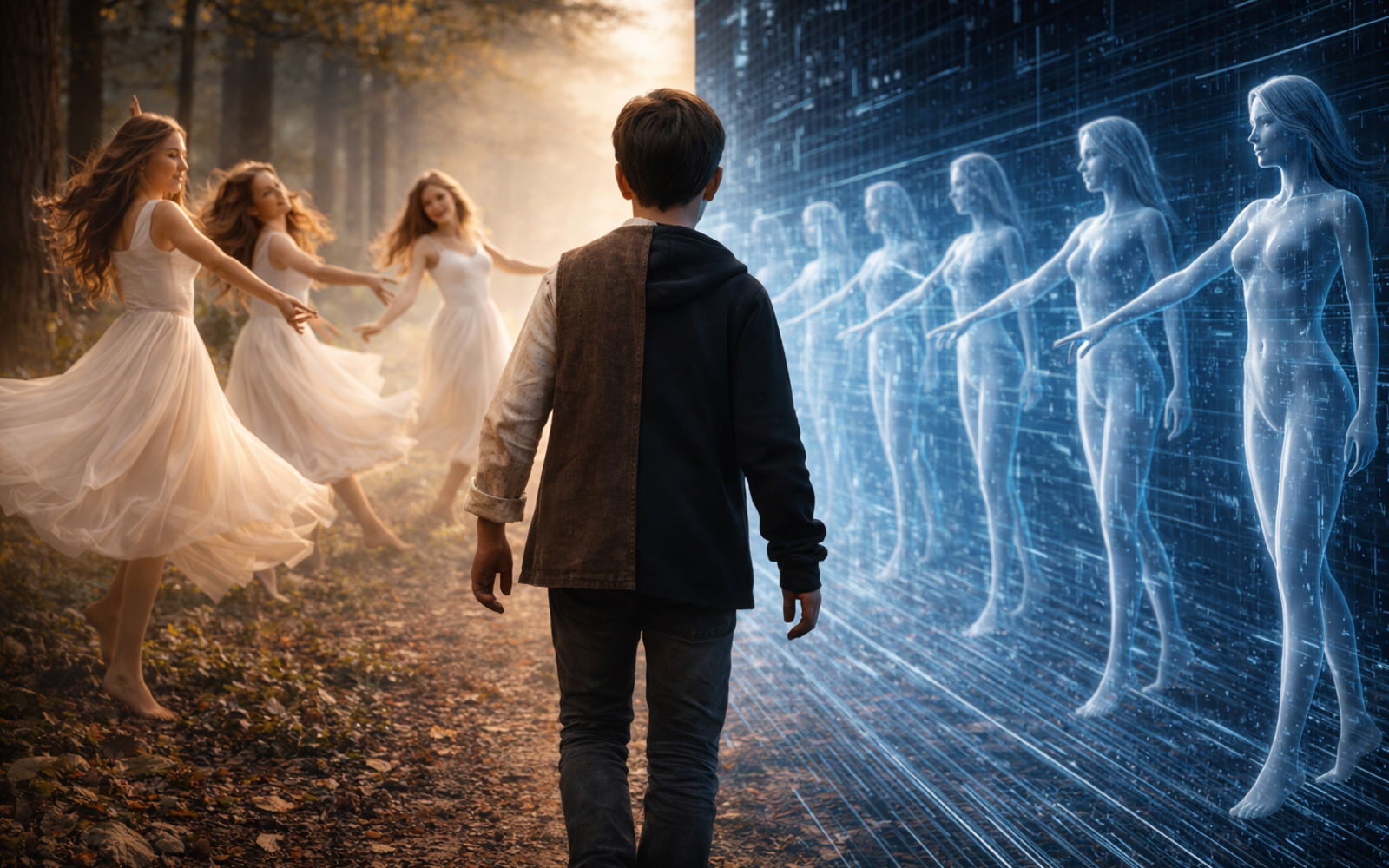
At the centre of the visual concept lies transformation. Each of the song’s eight verses is accompanied by its own distinct visual world, presenting the original work and its modern AI interpretation side by side. This duality runs consistently throughout the entire video and is realised through a clear, recurring visual structure in which historical and contemporary elements merge into a single, unified reality.
From the very beginning, the intro sequence introduces the viewer to the theme through a deliberately crafted text. The narrative then opens with a central depiction of father and son, whose appearances each combine elements of Goethe’s era and the present day. This principle is carried forward and intensified in the scenes that follow.
The Erlking himself initially appears in a split form as well—half mythological figure from the original narrative, half digital artificial intelligence. In the subsequent scenes, the sense of threat gradually intensifies. At first, the Erlking reaches out to the boy from behind; later, classical and modern manifestations appear simultaneously. The staging becomes increasingly dense and subtly layered, as both the daughters of the original Erlking and digital avatars emerge as parallel forms.
While the father—both in his historical and modern representations—tries to calm the boy, the decisive turning point occurs in the seventh scene. The boy yields to the seduction and sets out on his final path. The concluding visual sequence reduces the narrative to its essence, leaving only traces of the boy behind.
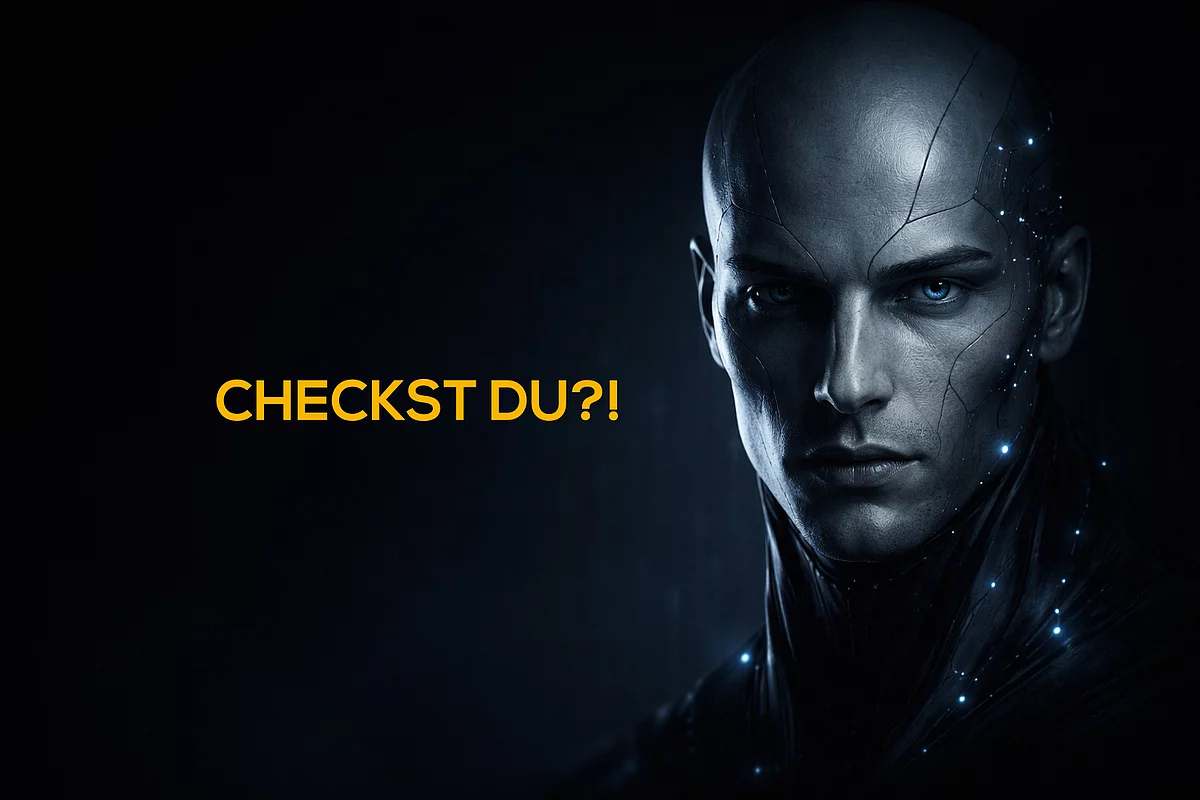
The final outro scene, with the striking line “Do you get it?”, functions as a deliberate thematic intensifier. It shifts responsibility to the viewer and poses the central question of the entire project: how we perceive this new form of seduction—and how we choose to respond to it.
“The Erlking 2026 is not a song about the future.
It is a song about our choices in the present.”
— Halumina —